
Most cats should move from kitten food to adult cat food at around 12 months of age, and large, slow-growing breeds such as Maine Coons may need kitten food for up to 18 months. Knowing when to switch from kitten food to adult cat food is only half the job, though. The change itself should be gradual, portions usually need adjusting at the same time, and a few cats need extra help accepting the new food. This guide covers how to tell whether your cat is ready, a day-by-day transition plan, and what to do when the plan stalls.
Quick answer
- Most cats are ready for adult food at about 1 year old, or once they reach maturity.
- Large breeds such as the Maine Coon can take up to 18 months to mature.
- Make the change over 7 to 14 days by mixing the two foods, and slow down if your cat's stomach objects.
- If your cat eats a food labeled for "all life stages," you may not need a new food at all. The portion size still changes.
This article is general information and does not replace advice from a veterinarian who knows your cat. If your cat has a medical condition or is on a prescription diet, ask your vet before changing foods.
Why kitten food and adult food are formulated differently
A kitten builds bone, muscle, and organs at a pace it will never repeat. VCA Animal Hospitals notes that growing kittens need higher amounts of all nutrients than adult cats, and specifically more calcium. Pet food regulators reflect this in the labels. AAFCO, which sets the model nutrient profiles used in the US, explains that different life stages need different quantities and ratios of nutrients, and the FDA points out that a growing kitten has different nutritional requirements than an older, spayed or neutered pet.
In practice, this means two things. A kitten moved to adult food too early gets a diet designed for maintenance rather than growth. An adult cat left on kitten food gets more calories than it needs, and VCA warns that kitten food may be too rich for adult cats and can lead to excess weight gain.
When to switch from kitten food to adult cat food
Age is the usual starting point, but growth and breed decide the final timing. Use all three together.
Age: around the first birthday
The 2021 AAHA/AAFP Feline Life Stage Guidelines, written for veterinarians, define the kitten stage as birth up to 1 year and the young adult stage as 1 to 6 years. The Merck Veterinary Manual recommends a kitten diet until adulthood, at about 9 to 12 months of age. VCA's guidance on switching is to make the change either at 1 year of age or when your cat has reached maturity.
Growth: is your cat close to adult size?
VCA considers most cats mature once they have reached 80 to 90 percent of their predicted adult size. Growth is fast early on and then tapers: kittens approach 80 percent of adult size at about 30 weeks and reach adult body size at about 40 weeks, according to VCA. If you have been weighing your kitten regularly (as you should during the first year), the weight curve flattening out over several weigh-ins is a good sign that growth is nearly done.
Breed and size: large cats grow for longer
VCA notes that maturity may take up to 18 months for large-breed cats such as Maine Coons. If you share your home with one, or with a big mixed-breed cat, expect to stay on kitten food past the first birthday and let your veterinarian confirm the timing. Our guides to Maine Coon cat mixes and the solid blue Maine Coon cover what to expect from these larger cats.
| Your cat | Typical time to switch | What to check first |
|---|---|---|
| Most domestic cats | Around 12 months | Weight has leveled off; vet agrees |
| Large or slow-maturing breeds (for example, Maine Coon) | Up to about 18 months | Still growing at 1 year? Stay on kitten food longer |
| Cat gaining too much fat on kitten food | Ask your vet about adjusting portions or switching | Body condition score |
| Cat eating an "all life stages" food | No food change needed | Adjust the portion to the adult feeding directions |
Signs your cat may be ready for adult food
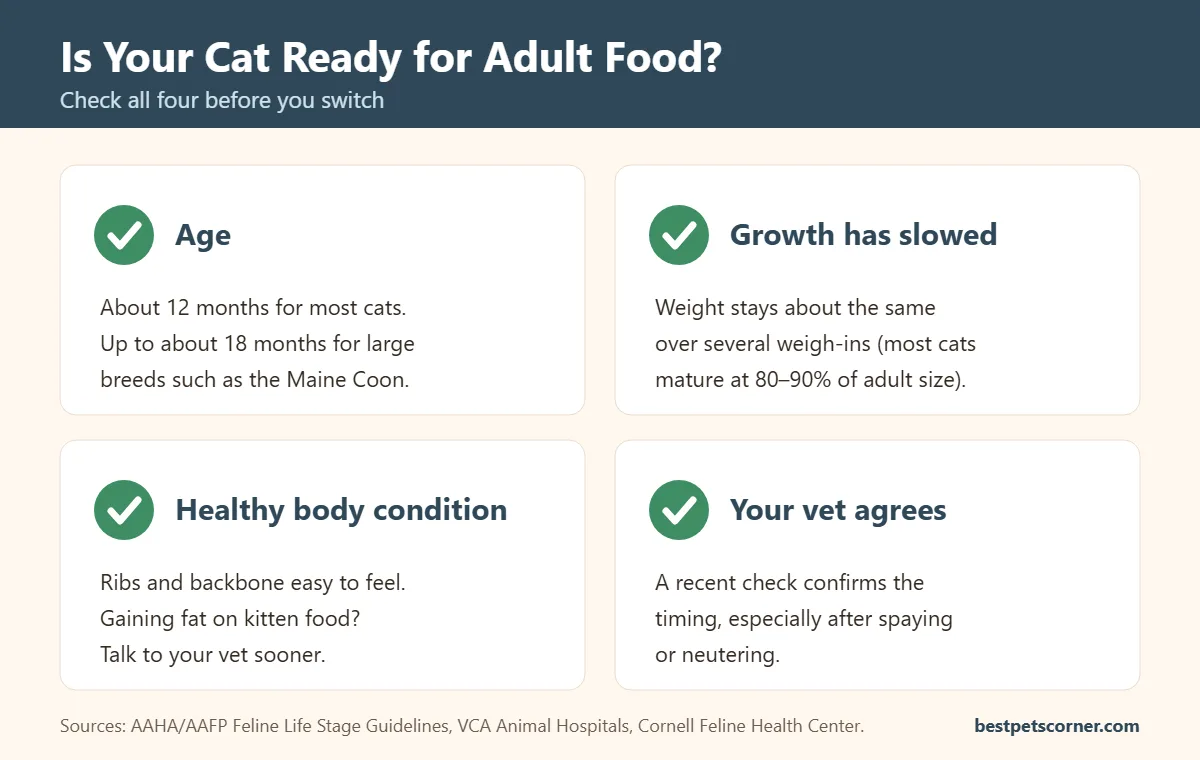
Before you buy the first bag of adult food, check these points:
- Your cat is about 12 months old, or closer to 18 months for a large breed.
- Its weight has stayed roughly the same over the last few weigh-ins.
- You can still feel the ribs and backbone easily. If your cat is starting to look padded on kitten food, that is a reason to talk to your vet sooner rather than later.
- Your veterinarian has seen your cat recently and agrees the timing makes sense.
Spaying, neutering, and your cat's calorie needs
Many cats are spayed or neutered months before they are ready for adult food. The ASPCA recommends that cats be spayed or neutered by five months of age. VCA explains that neutering decreases a cat's metabolism and may lead to a more sedentary lifestyle, so owners should make appropriate adjustments to their cat's nutrition.
The practical consequence is that your cat's energy needs can drop while it is still eating calorie-dense kitten food. Weigh your cat in the weeks after surgery and ask your veterinarian whether the daily portion should come down. Don't wait for the food switch to fix a weight trend that started earlier.
What happens if you switch too early or too late?
Switching early means feeding adult maintenance food as the main diet while your kitten is still growing. That food isn't formulated to meet growth requirements, which is why the timing advice above leans on growth as well as age.
Switching late is the more common problem. Kitten food is richer, and Cornell's Feline Health Center describes obesity as the most common nutrition-related problem in cats. A few extra months on kitten food, combined with the lower energy needs after neutering, can add up.
"All life stages" foods: do you need to switch at all?
Check the nutritional adequacy statement on your current bag or can. VCA notes that a food formulated for all life stages is also appropriate for growth. If that is what your kitten already eats, you may be able to keep the same food into adulthood.
What changes is the amount. AAFCO says all-life-stage products should have different feeding directions for different life stages, so follow the adult directions once your cat has finished growing, and adjust from there based on weight. If you are unsure whether to stay with an all-life-stages food or move to an adult formula, your veterinarian can help you decide.
How to switch: a 10-day transition plan
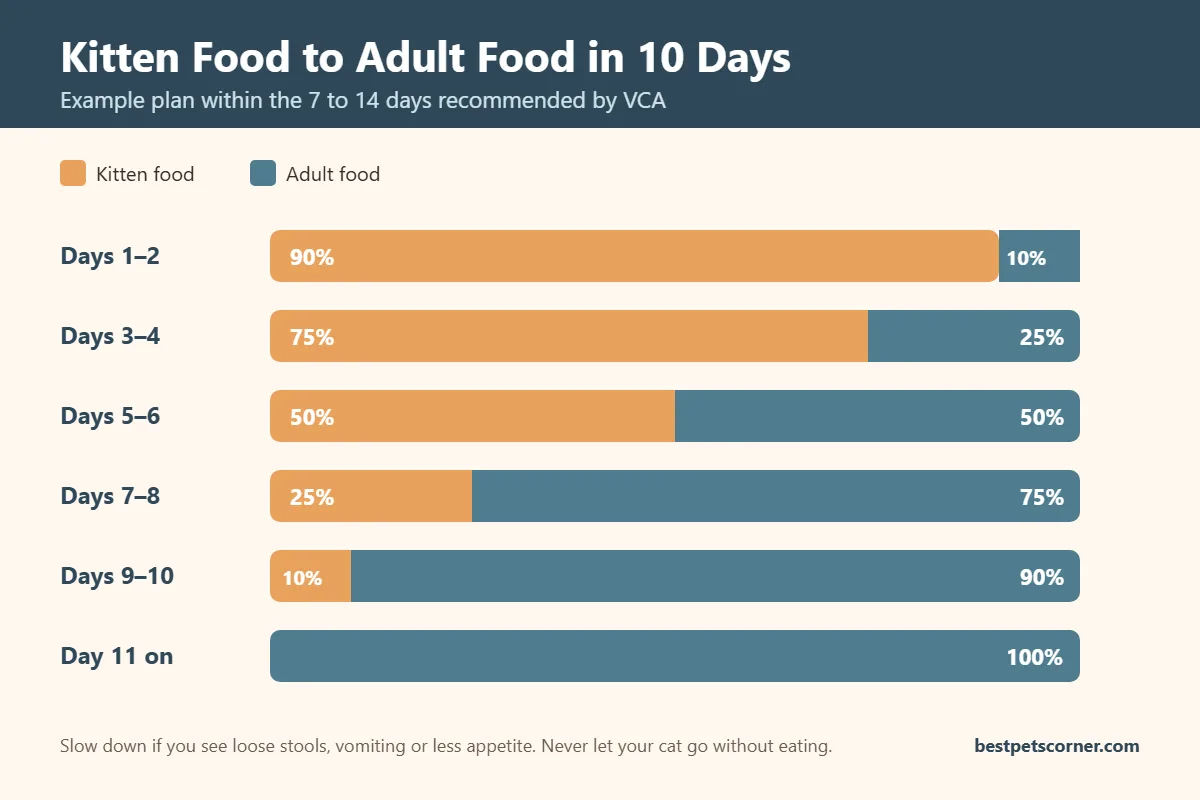
VCA recommends moving to the new food gradually over 7 to 14 days, starting with about 90 percent kitten food and 10 percent adult food on day one. The schedule below is one example that fits inside that range. Stretch any step if your cat needs more time.
| Days | Kitten food | Adult food |
|---|---|---|
| 1 to 2 | 90% | 10% |
| 3 to 4 | 75% | 25% |
| 5 to 6 | 50% | 50% |
| 7 to 8 | 25% | 75% |
| 9 to 10 | 10% | 90% |
| 11 onward | 0% | 100% |
A few habits make the transition smoother:
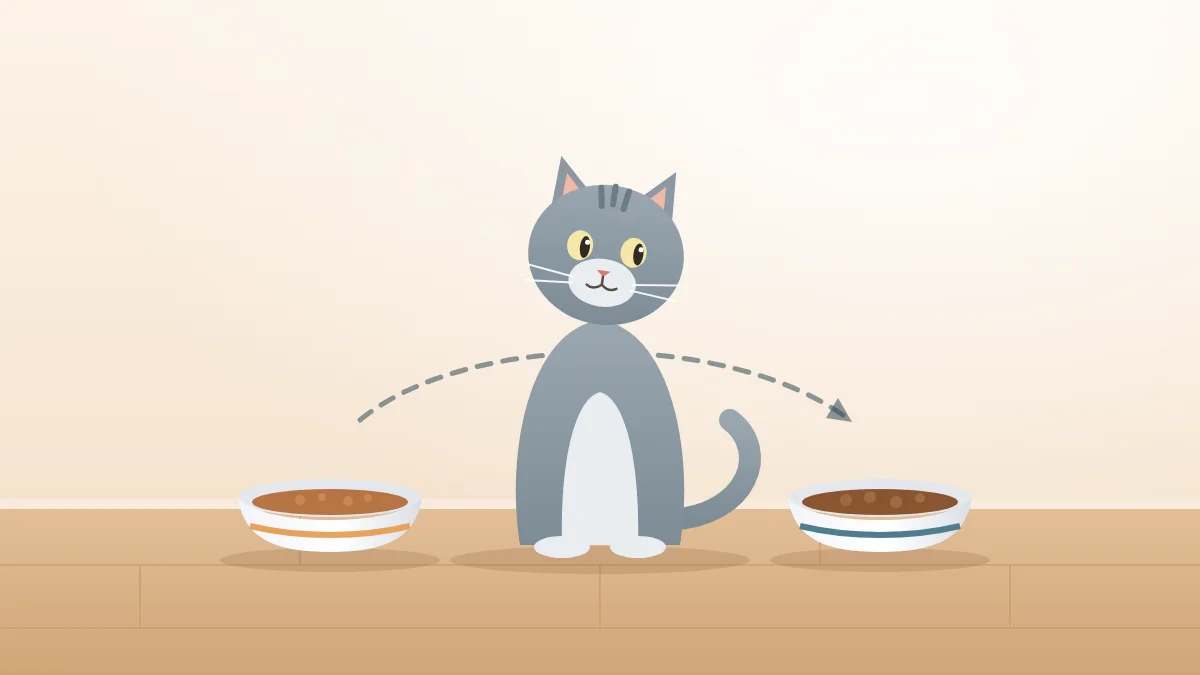
- Mix the two foods together in the same bowl so your cat can't pick out the familiar one.
- Change one thing at a time. If you are also switching brands or moving from dry to wet food, a problem is easier to trace when only one variable changes.
- Watch the litter box. VCA advises slowing the transition if your cat develops loose stools, vomiting, or a decreased appetite.
Switching when you feed both wet and dry food
Percentages by volume can mislead you, because kitten food and adult food rarely have the same calorie density. A quarter cup of one kibble may contain noticeably more energy than a quarter cup of another. It is more accurate to split the day's calories.
Under the model regulations published by AAFCO, which US states adopt into their own rules, cat food labels carry a "Calorie Content" statement in kilocalories per kilogram and per familiar unit, such as per cup or per can. With that number, the math is simple. Here is an example for day 5, the 50/50 point, with made-up label values:
| Step | Calculation | Result |
|---|---|---|
| Daily target | From your vet or the feeding guide | 200 kcal |
| Kitten food half | 100 kcal ÷ 440 kcal per cup | About 3½ tbsp |
| Adult food half | 100 kcal ÷ 400 kcal per cup | ¼ cup (4 tbsp) |
If you feed wet food as well, count its calories first and cover the rest with kibble, exactly as in our kitten feeding schedule and calorie method. A digital kitchen scale and a standard measuring cup (not a coffee mug) make the numbers reliable.
What to do if your cat refuses the new food
Cornell lists dislike of a new food among the reasons a cat may stop eating, so some resistance is normal. Go back to the last mix your cat accepted and stay there for a few extra days before trying the next step. Warming wet food slightly or trying the adult version of the same brand are reasonable things to try.
What you should not do is wait your cat out. Cornell warns that a cat that refuses to eat can develop serious medical problems, notes that rapid weight loss in cats carries a risk of hepatic lipidosis (fatty liver disease), and advises seeing a veterinarian if appetite loss lasts as little as 24 hours. If your cat skips meals during the transition, offer the familiar food again and call your vet.
For the future, Cornell suggests that feeding two or three different cat foods can keep a cat from developing an exclusive preference for one. Once your cat is settled on adult food, occasionally rotating between a couple of complete and balanced adult foods may make later changes easier.
How much adult food to feed after the switch
Start with the feeding directions on the new food for your cat's current weight, then adjust. VCA cautions that the general guidelines on the back of the bag are not accurate for all cats, and that metabolism starts to slow around this age.
Body condition is the best check. Veterinarians use a 9-point body condition score where 5 is ideal; on Cornell's scale, a cat scoring above about 6.5 to 7 is classed as overweight. The WSAVA Global Nutrition Guidelines include a free body condition chart for cats that you can print. Treats count toward the day's calories: VCA suggests they make up no more than 10 percent, and Cornell gives 10 to 15 percent as an upper limit.
For meal frequency, the ASPCA recommends feeding adult cats twice a day using measured portions. Short play sessions help keep an indoor cat active, and our ideas for entertaining a cat in a small apartment work in any home.
When to call your veterinarian
Contact your vet if your cat stops eating or eats much less than usual, has vomiting or diarrhea that doesn't settle when you slow the transition, is losing weight, or is gaining weight quickly. Also ask before switching if your cat has a medical condition or eats a therapeutic diet.
Frequently asked questions
Can a 6-month-old kitten eat adult cat food?
Not as its main diet. At six months a kitten is still growing, and adult maintenance food is not formulated for growth. Keep the regular meals on kitten food (or an all-life-stages food) until your vet agrees your cat is mature.
Can adult cats eat kitten food?
They can eat it without immediate harm, but VCA notes that kitten food may be too rich for adult cats and can contribute to excess weight gain. In a home with a kitten and an adult cat, feed them separately so each eats its own food.
How long should the transition take?
VCA recommends 7 to 14 days. Some cats are happy with the new food in a week; others need the full two weeks or longer. The pace of your cat's appetite and stools matters more than the calendar.
Should I switch foods right after spaying or neutering?
Surgery often happens months before the switch, so the food change usually comes later. What matters after surgery is the portion. Because neutering lowers a cat's metabolism, ask your vet whether to reduce the amount of kitten food until your cat is ready for adult food.
The bottom line
The move from kitten food to adult cat food goes best when you plan it for around your cat's first birthday, later for large breeds, and confirm the timing with your vet using weight and body condition rather than age alone. Move over 7 to 14 days, split by calories if you feed more than one food, and never let a reluctant cat go without eating. Watch the portions after neutering and after the switch, since that is when weight gain usually starts. If you are still choosing a kibble for the months before the switch, our guide to the best dry cat food for kittens explains what to look for.
Sources
- AAHA/AAFP: 2021 Feline Life Stage Guidelines
- VCA Animal Hospitals: When to Switch Your Kitten to Adult Food
- VCA Animal Hospitals: Feeding Growing Kittens
- VCA Animal Hospitals: Can You Overfeed a Kitten?
- VCA Animal Hospitals: Neutering in Cats
- Cornell Feline Health Center: Feeding Your Cat, Obesity, Anorexia
- Merck Veterinary Manual: Kitten Care
- ASPCA: General Cat Care
- AAFCO: Reading Labels, Calories
- U.S. Food and Drug Administration: "Complete and Balanced" Pet Food
- WSAVA: Global Nutrition Guidelines