
A kitten not using the litter box is one of the most common problems new owners run into. The cause usually falls into one of three groups: a health problem, something about the box or litter the kitten doesn't like, or stress. This guide walks you through ruling out medical issues first, reading the clues in where the accidents happen, and fixing the setup so your kitten goes back to the box.
Quick answer
- See your vet first to rule out a medical cause, such as a urinary tract problem or diarrhea.
- Offer one box per cat plus one, scoop at least daily, and use an unscented clumping litter about 1 to 2 inches deep.
- Put boxes in quiet, easy-to-reach places, away from food bowls, with one on each floor of your home.
- Clean accidents with an enzymatic cleaner and never scold your kitten.
Go to a vet right away if your kitten or cat is straining in the litter box and passing little or no urine. VCA Animal Hospitals explains that a complete urinary obstruction, which happens almost exclusively in male cats, can be life-threatening if untreated.
This article is general information and does not replace an examination by a veterinarian.
Step 1: Rule out a medical cause
Both the ASPCA and VCA advise ruling out medical problems before treating litter box trouble as a behavior issue. A kitten that feels pain or urgency when it goes can start to link the box with that discomfort and look for somewhere else.
For kittens specifically, VCA notes that urinary tract infections can occur secondary to chronic diarrhea. In cats more generally, VCA lists colitis, constipation, and anal sac disease among the conditions that can lead to soiling outside the box, and describes feline idiopathic cystitis (FIC), a bladder inflammation that can lead to urethral obstruction, particularly in male cats.
Book a vet visit if you notice any of these:
- repeated trips to the box, or straining with little or nothing coming out;
- diarrhea, very hard stools, or blood in urine or stool;
- crying or discomfort while eliminating;
- a kitten that was reliably using the box and suddenly stopped.
Bring a fresh stool sample if you can, and write down when the accidents started and where they happen. That information helps your vet and is also what you need for the next step.
Step 2: Read the clues in where the accidents happen
Once your vet has ruled out illness, the pattern of accidents usually points to the cause. The ASPCA groups litter box problems into a few categories, including a dislike of the litter, the location, or the box itself, a preference for certain surfaces, and stress.
| What you see | Likely cause | What to try first |
|---|---|---|
| Urine or stool right next to the box | The box is dirty, too small, too deep in litter, or hard to climb into | Scoop more often; try a bigger box with low sides |
| Accidents on soft things: rugs, beds, laundry | Surface preference or litter dislike | Try a softer, finer clumping litter; limit access to the favored spot |
| Accidents always in the same spot far from the box | Location preference or aversion | Put a box where the accidents happen |
| Urine sprayed on walls or furniture (vertical surfaces) | Marking, which VCA calls spraying | Talk to your vet; marking is treated differently |
| Problems started after a move, new pet, or new litter | Stress or a change the kitten doesn't like | Go back to the old litter; give a quiet, safe box location |
| Uses the box for urine but not stool, or the reverse | Possible discomfort (for example, constipation or diarrhea) or a box issue | Vet check; offer a second box nearby |
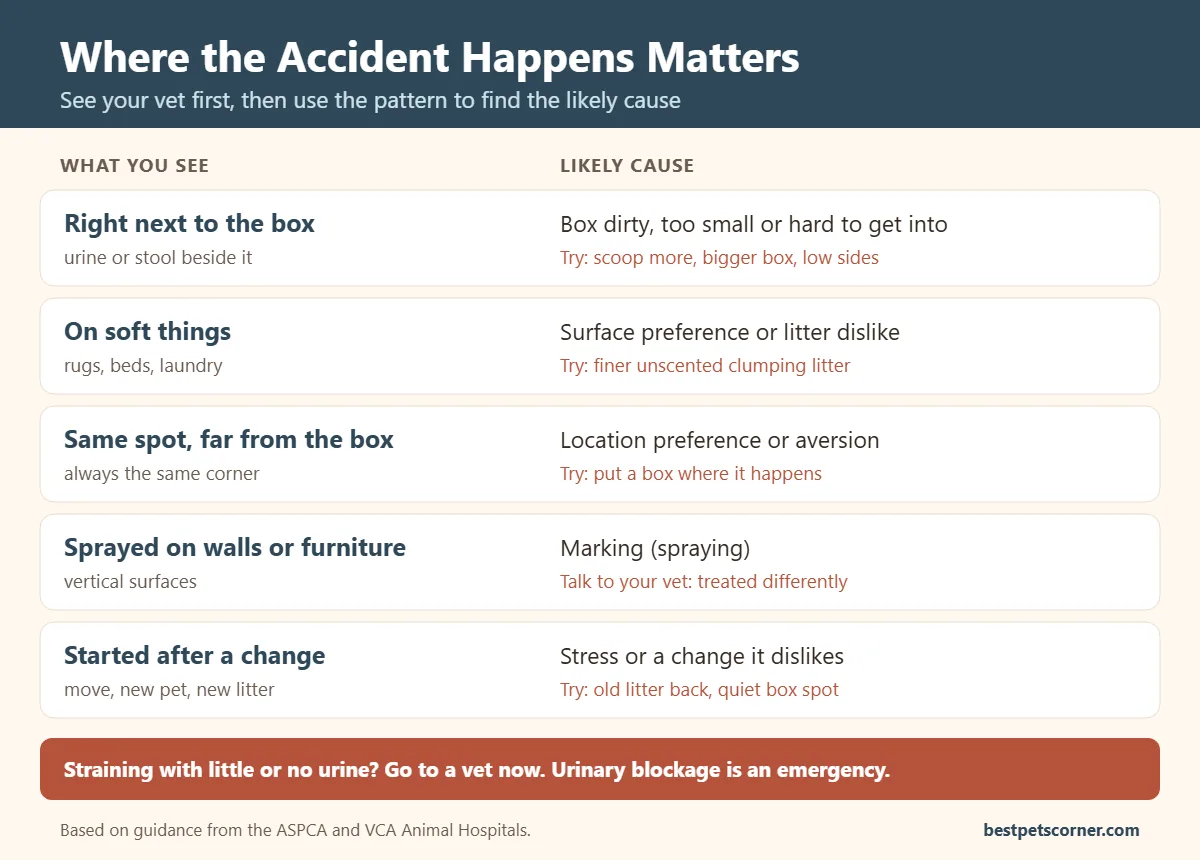
VCA explains that urinating on vertical surfaces is called spraying, and it describes marking behavior in unaltered cats, particularly males. The ASPCA points out that the cause and treatment of marking are entirely different from other litter box problems, so if you see spraying, raise it with your vet rather than only changing the litter.
Step 3: Fix the litter box setup
How many litter boxes do you need?
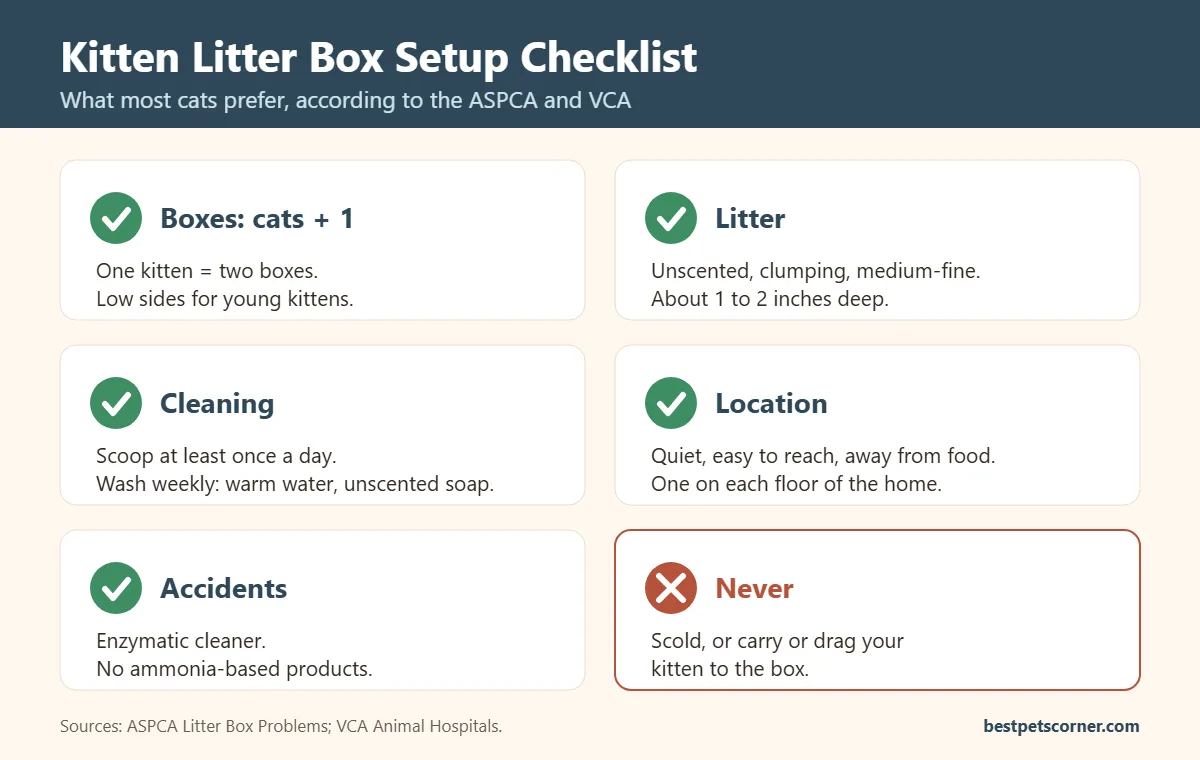
VCA's rule is to have as many litter boxes as you have cats, plus one, and the ASPCA gives the same advice. One kitten therefore needs two boxes. A spare box means there is always a clean option, and in a home with several cats it stops one cat from blocking another's access.
The right box for a small kitten
The ASPCA says most cats prefer large boxes they can enter easily, and it suggests a box with low sides for cats that are still very young. If your kitten's box has a lid, the preference test below is an easy way to find out whether it would rather have an open box.
Which litter to use
According to the ASPCA, most cats prefer clumping, unscented litter with a medium to fine texture, about 1 to 2 inches deep rather than 3 to 4. The ASPCA also notes that a cat may prefer the type of litter it used as a kitten, so if you know what your kitten used at the shelter or breeder, start with that and change gradually if you need to.
How often to clean the box
Scoop at least once a day. For a full clean, the ASPCA recommends washing every box once a week with warm water and unscented soap. Some VCA pages suggest deep-cleaning less often, so treat weekly as the safer target while your kitten is having problems.
Where to put the box
The ASPCA advises keeping boxes away from busy, loud, or intimidating places, such as next to a washing machine, and providing a box on each level of a multi-story home. VCA adds that cats don't want to eliminate near their food bowls. A small kitten exploring a big house may simply not get back to a distant box in time.
Step 4: Run a litter box preference test
VCA suggests a litter box preference test when you can't tell what your kitten dislikes. The idea is to let your kitten choose:
- Set up two or three boxes side by side in a quiet spot.
- Change one thing between them, for example a different litter in each box, or one box with a lid and one without.
- Keep everything else the same and scoop each box daily.
- After several days, note which box your kitten uses most. That is your answer for that variable.
- Test the next variable (box size, location) the same way if the problem continues.
Step 5: Clean accidents the right way
The ASPCA recommends cleaning accidents thoroughly with an enzymatic cleaner made to neutralize pet odors and warns against ammonia-based cleaners. Blot urine first, then follow the cleaner's directions. For general tips on keeping a home with cats smelling clean, see our guide on keeping your house fresh with a cat.
Step 6: Lower stress and restart the routine
VCA notes that changes in the home can cause anxiety and stress in cats, and the ASPCA lists stress as a cause of litter box problems. A move, a new pet, visitors, or a change of litter can all count. VCA also suggests pheromone diffusers placed around the litter box area.
For a young kitten who has lost the habit, a short reset often helps. VCA notes that getting a kitten to use the box can be as simple as keeping it in a room with the litter box. Keep your kitten in one small room with its bed, food and water on one side and the box on the other for a few days, then give access to the rest of the house gradually. Daily play also helps an anxious kitten settle; our ideas for entertaining a cat in a small apartment work in any home.
Diet changes can also upset a kitten's digestion. If you are changing foods, do it gradually; our guide to switching from kitten food to adult cat food includes a day-by-day plan.
If you have more than one cat
The one-per-cat-plus-one rule matters most here, because a second cat can make a box feel off limits to a newcomer. Putting the boxes in different rooms, with at least one on each floor as the ASPCA advises, gives a nervous kitten more than one place to go.
Sometimes you don't know which cat is having accidents. The ASPCA describes a way to find out: your vet can give one of the cats fluorescein, a harmless dye that makes its urine glow under a black light. Knowing which cat is involved tells you whose health to check first and whose routine to adjust.
A one-week reset plan
Here is how the steps above fit together over the first week. Treat the timing as an example and adjust it to your kitten and your vet's advice.
| When | What to do |
|---|---|
| Day 1 | Book a vet visit (or go straight away if there are warning signs). Clean every accident spot with an enzymatic cleaner. Start a simple log of when and where accidents happen. |
| Day 1 to 2 | Add a second box, scoop daily, and switch to unscented clumping litter about 1 to 2 inches deep if you weren't using it already. |
| Day 2 to 7 | Keep your kitten in one quiet room with food and water on one side and the box on the other. Start a preference test if the log shows a pattern. |
| Week 2 | Give access to the rest of the house a room at a time, with a box on each floor. Keep the log going. |
| Week 3 onward | If accidents continue despite a clean bill of health, go back to your vet and ask about a veterinary behaviorist. |
The log is more useful than it sounds. A week of notes such as "urine on the bath mat, morning, after the box was scooped late" often makes the cause obvious, and it gives your vet facts instead of impressions.
What not to do
- Don't scold your kitten or carry or drag it to the box; the ASPCA specifically advises against this.
- Don't clean with ammonia-based products.
- Don't switch to a scented or very different litter all at once.
- Don't give any medication for a behavior problem without your veterinarian's advice, as the ASPCA cautions.
When to get more help
Call your vet straight away for the warning signs above. If the medical checks are clear and a few weeks of setup changes haven't helped, ask your vet about a referral to a veterinary behaviorist. Litter box problems are common: the ASPCA says at least 10 percent of all cats develop elimination problems, so you are far from alone.
Frequently asked questions
Why is my kitten peeing on my bed?
The ASPCA lists surface preference, where a cat favors eliminating on certain textures, alongside litter and location aversions and stress as common causes. Rule out a medical cause first, wash the bedding with an enzymatic product, keep the bedroom door closed for a while, and review the box setup above.
Why does my kitten pee in the box but poop outside it?
It can be a medical clue. VCA lists constipation and colitis among the conditions behind soiling in cats, so mention the pattern to your vet. If your kitten is healthy, add the second box recommended above and place it near the spot it has been using.
How many litter boxes does one kitten need?
Two. Both VCA and the ASPCA recommend one box per cat plus one extra. In a home with more than one floor, place them on different levels.
The bottom line
When a kitten is not using the litter box, start with the vet, then let the accident pattern guide you. Most problems improve with a cleaner, bigger, easier-to-reach box, unscented clumping litter, an enzymatic cleanup, and a calmer routine. Change one thing at a time so you can see what works, and don't scold your kitten for accidents.
New to kittens? Our kitten feeding schedule covers the other daily routine that matters most in the first year.
Sources
- ASPCA: Litter Box Problems
- VCA Animal Hospitals: Why Is My Kitten Not Using the Litter Box?
- VCA Animal Hospitals: Behavioral Inappropriate Urination in Kittens
- VCA Animal Hospitals: Cat Behavior Problems: House Soiling
- VCA Animal Hospitals: Cystitis and Lower Urinary Tract Disease in Cats