
Your kitten's food bag gives you one number, your kitten acts like it isn't enough, and every website seems to suggest a different schedule. This guide explains how much to feed a kitten at each stage of the first year, how often to offer meals, and how to use calories to set portions when you feed both wet and dry food.
Quick answer
- How much: start with the daily amount on your food's label for your kitten's age and weight. That amount is for the whole day, not for one meal.
- How often: about 3–4 small meals a day until six months, then about 2–3 meals until your kitten is around one year old.
- Wet and dry together: split the day's calories between the two foods. Don't give the full label amount of each.
- What: a food labeled "complete and balanced" for growth or for all life stages.
- Adjust: weigh your kitten regularly, check its body condition, and change portions gradually with your veterinarian's input.
This article is general information, not a substitute for veterinary advice. Kittens with health problems, orphaned kittens, and kittens that are not gaining weight need individual guidance from a veterinarian.
Why kittens need their own feeding plan
Kittens grow fast. The ASPCA notes that a kitten's body weight may double or even triple in the first weeks of life, and that kittens need about two to three times the energy of an adult cat. The Cornell Feline Health Center adds that kittens need more food per pound of body weight than adults. Because their stomachs are small, the usual approach is several small meals spread over the day.
More food isn't always better, though. VCA Animal Hospitals warns that pushing for maximum growth raises a kitten's risk of becoming overweight. That kind of fast growth usually comes from high-energy foods, overfeeding, or unlimited free-choice feeding. The goal is steady growth into a healthy adult.
Kitten feeding schedule by age
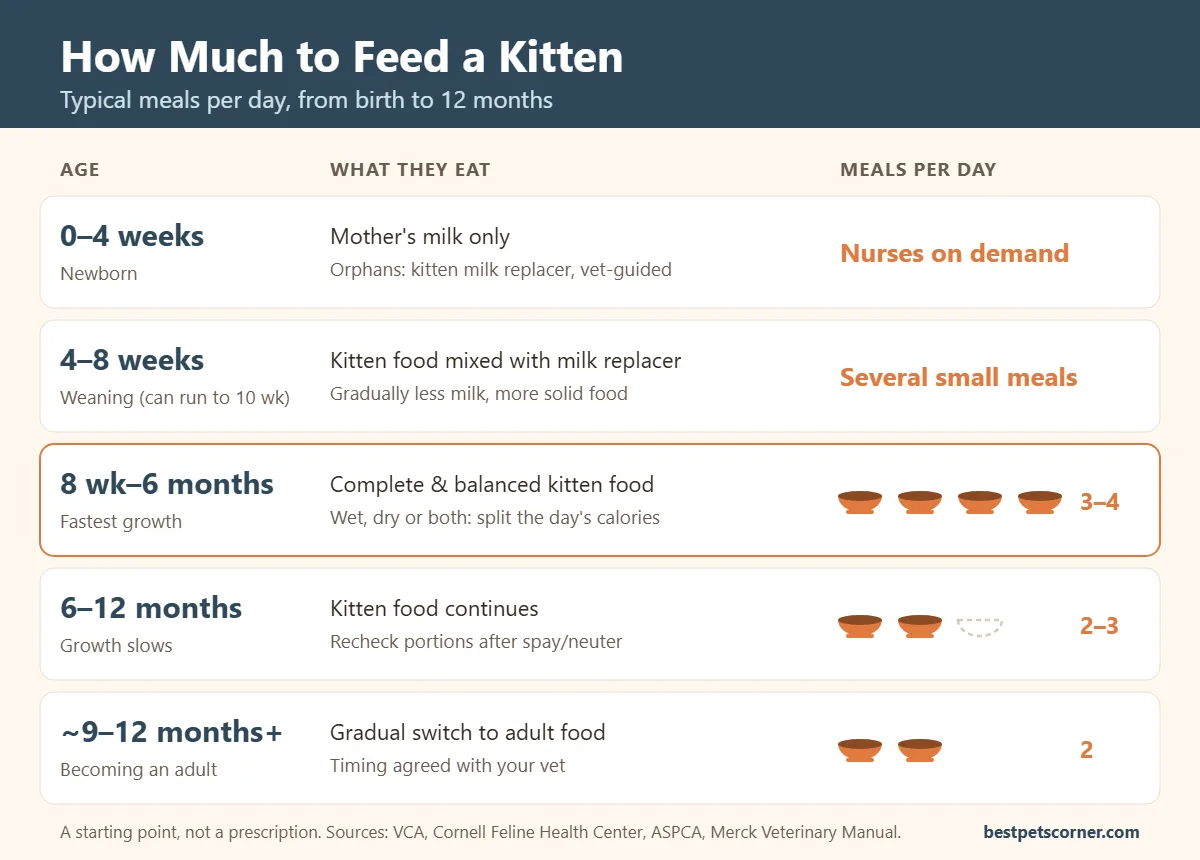
Veterinary sources give slightly different numbers, so the table shows typical ranges rather than strict rules.
| Age | What they eat | Meals a day |
|---|---|---|
| 0–4 weeks | Mother's milk (orphans: kitten milk replacer, never cow's milk) | Nurses on demand |
| 4–8 weeks* | Gruel of kitten food and milk replacer, made thicker over time | Several small meals |
| 8 weeks–6 months | Complete and balanced kitten food | 3–4 |
| 6–12 months | Kitten food | 2–3 |
| 9–12 months+ | Gradual switch to adult food (ask your vet) | 2 |
Birth to 4 weeks: milk only
According to the ASPCA, kittens get complete nutrition from their mother's milk for about the first four weeks of life. If you are caring for orphaned newborns, contact a veterinarian right away for a milk replacer and a feeding plan. The ASPCA advises against cow's milk, which can cause stomach upset and diarrhea in some kittens.
4 to 8 weeks: weaning
The ASPCA says weaning usually starts at around four weeks and is finished by eight to ten weeks. VCA puts full weaning at about 8 weeks. The ASPCA describes mixing kitten food with kitten milk replacer to an oatmeal-like consistency. Over the following weeks, you use less replacer and more food.
8 weeks to 6 months: the fastest growth
This is when most kittens go to their new homes. VCA says most kittens do best with the daily portion divided into three to four small meals or more. Cornell recommends three meals a day until about six months.
6 to 12 months: fewer, larger meals
Cornell suggests twice-daily feeding is generally best from six months to one year. Some owners keep a third small meal if it fits their kitten's routine. Spaying or neutering often happens during this period. The FDA points out that a growing kitten's nutritional needs differ from those of an older spayed or neutered pet, so ask your veterinarian whether portions should change after the surgery.
Around one year: moving to adult food
The Merck Veterinary Manual recommends kitten food until adulthood, at about 9 to 12 months. The ASPCA and Cornell both point to about one year. Your veterinarian can help you choose the right time. When you switch, Cornell advises continuing to feed some of the old food while you gradually move to the new one.
How much to feed a kitten: work out portions with calories
Measuring by volume can mislead you, because foods differ a lot in calorie content. A quarter cup of one kibble does not equal a quarter cup of another. Calories let you compare foods directly and combine wet and dry food without overfeeding.
Under the model regulations from AAFCO, which US states adopt, pet food labels show a "Calorie Content" statement in kilocalories (kcal) per kilogram and per familiar unit, such as per cup or per can. That figure is all you need for the method below.
Step-by-step calorie method
- Find your kitten's daily calorie target. Ideally, ask your veterinarian. If you don't have a number yet, take the label's daily amount for your kitten's age and weight and multiply it by the kcal per unit. Weigh your kitten first rather than guessing.
- Set aside a small treat allowance of 5% of the daily calories. This is the strictest of the published guidelines (see "How many treats can a kitten have?" below). Subtract it from the target.
- Decide how much wet food to give and count its calories. For example, one can per day.
- Cover the remaining calories with dry food. Divide the calories left by the kcal per cup of the dry food.
- Split the total across the day's meals.
- Weigh your kitten again regularly and adjust. Cornell cautions that label feeding instructions may not match your cat's needs, so you could end up feeding more than necessary.
Worked example (hypothetical numbers)
Suppose your dry food has 400 kcal per cup and its label suggests ½ cup a day for your kitten. Your wet food has 90 kcal per 3-oz can.
| Step | Calculation | Result |
|---|---|---|
| Daily target | ½ cup × 400 kcal | 200 kcal |
| Treats (5%) | 5% × 200 kcal | 10 kcal |
| Wet food | 1 can × 90 kcal | 90 kcal |
| Dry food | (200 − 10 − 90) ÷ 400 | ¼ cup |
| Per meal (×4) | ¼ can + 1 tbsp dry | ≈ 48 kcal |
Without the calorie step, it's easy to give the full label amount of wet food and the full label amount of dry food. That roughly doubles the day's calories. If your wet and dry food labels suggest different daily totals, ask your veterinarian which target to use, and let the regular weigh-ins guide you. A digital kitchen scale and a standard measuring cup (not a mug) make portions much more consistent.
Check body condition, not just the scale
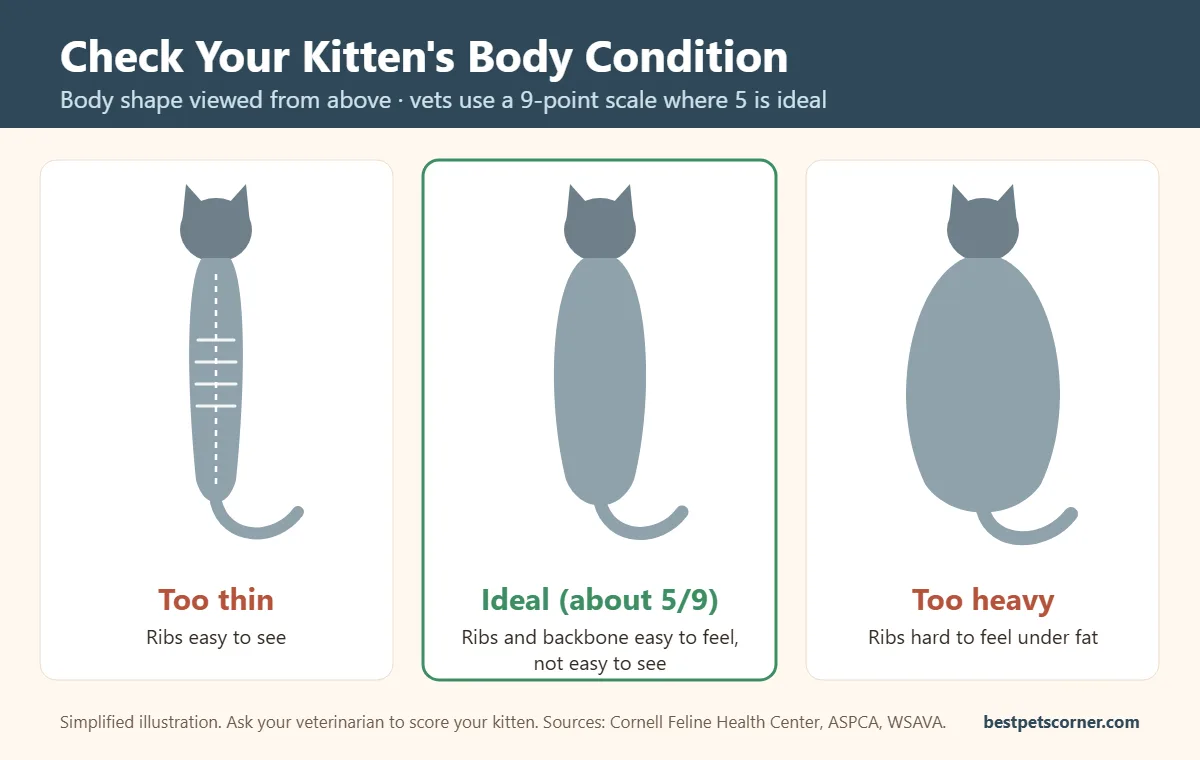
VCA recommends regular weigh-ins and body condition checks while a kitten grows. Veterinarians often use a 9-point body condition score where 5 is ideal. Cornell describes the extremes: ribs visible at the low end, and ribs that can't be felt under heavy fat at the high end. At a healthy weight, the ASPCA says you should be able to feel the backbone and ribs. The WSAVA Global Nutrition Guidelines offer free body condition charts for cats, and your veterinarian can score your kitten at each visit.
Choosing a food: read the label
Look for the nutritional adequacy statement. VCA says it should state that the food is formulated to meet the requirements for growth. A food for all life stages is also appropriate. The FDA explains that "complete and balanced" means the product is intended as the pet's only diet, while treats and snacks usually are not.
VCA notes that a purpose-formulated kitten food should have everything your kitten needs. Cornell warns that supplements can be harmful and should never be given without a veterinarian's approval. If you're comparing kibbles, our guide to the best dry cat food for kittens covers what to look for.
Scheduled meals or free feeding?
The sources don't fully agree. The ASPCA says kittens can be fed free-choice and that this works best with dry food, which won't spoil if left out. VCA says free-choice feeding can increase the risk of excess body fat, and that portion feeding gives the best chance of preventing obesity. Cornell notes that free feeding suits some cats but leads others to overeat.
| Measured meals | Free feeding (dry only) | |
|---|---|---|
| Portion control | Easy to adjust | Hard to track |
| Appetite changes | Noticed quickly | Easy to miss |
| Several pets | Each pet's intake known | Others may eat it |
| Busy schedules | Needs a person or timed feeder | Convenient |
| Wet food | Works well | Not suitable |
For most homes, measured meals at regular times are the practical choice. They also make the calorie method above easy to follow. If no one is home at midday, a timed feeder can serve a small, measured dry meal. Many kittens also enjoy a short play session before eating. Try our ideas for entertaining a cat in a small apartment.
Water, milk, and treats
- Water: Cornell and the ASPCA both say cats should always have clean, fresh water available.
- Milk: Cornell says milk isn't generally recommended because many cats are lactose intolerant. Weaned kittens don't need it.
- Treats: keep them to about 5% of daily calories. The next section explains why.
How many treats can a kitten have?
Published treat limits differ, partly because they apply to different animals and are measured in different ways. The ASPCA's nutrition advice is that treats should make up no more than 5% of a kitten's daily nutrient intake. Cornell's rule of thumb for cats in general is no more than 10–15% of daily calories. The ASPCA's general cat-care page gives 5–10%.
A growing kitten should get almost all of its nutrition from a complete and balanced growth food. For that reason, we recommend the strictest of these figures, 5%, counted in calories. In the worked example above, that's 10 kcal a day. Using pieces of your kitten's regular kibble as training rewards keeps treats within that limit.
Common kitten feeding mistakes
- Giving the daily amount at every meal. The label amount is for 24 hours.
- Using a chart made for a different food. Calorie content varies widely between foods.
- Switching to adult food too early. Adult maintenance foods aren't formulated for growth.
- Changing foods all at once. Mix the old and new foods while you transition.
- Adding supplements "just in case." Talk to your veterinarian first.
When to call your veterinarian
Appetite matters a lot in young kittens. Cornell warns that in kittens under six weeks old, refusing food for just 12 hours can be life-threatening, and that you should see a veterinarian as soon as you notice signs of appetite loss. Contact your veterinarian promptly if your kitten:
- refuses food or eats much less than usual;
- is losing weight, or is not gaining weight;
- is vomiting or has diarrhea;
- seems weak, lethargic, or "not right" to you.
Kittens do sleep a lot. Our article on cat sleeping habits explains what's typical for kittens, so you can tell normal rest from unusual tiredness.
Kitten feeding checklist
- ☐ The food is labeled complete and balanced for growth or all life stages
- ☐ You've weighed your kitten and set a daily calorie target
- ☐ Wet and dry food share that target
- ☐ Meals: 3–4 a day under six months, 2–3 a day from 6 to 12 months
- ☐ Fresh water is always available
- ☐ You recheck weight and body condition regularly
You may also find these helpful: calm breeds that suit indoor life.
Frequently asked questions
Can I overfeed my kitten?
Yes. VCA notes that overfeeding and free-choice feeding can increase a kitten's risk of excess body fat. Measured meals and regular body condition checks help prevent this.
My kitten always acts hungry. Should I feed more?
Begging alone isn't a reliable sign, because many kittens are enthusiastic eaters. Check weight and body condition first. If your kitten looks thin or isn't gaining weight, ask your veterinarian whether to increase portions and whether a health check is needed.
Can my kitten eat adult cat food?
Not as its main diet, unless the label says the food meets the requirements for growth or all life stages. Adult maintenance foods aren't formulated for growing kittens.
The bottom line
Figuring out how much to feed a kitten gets simpler once you work in calories. Choose a complete and balanced growth food. Set a daily calorie target from the label or your veterinarian, and share it among meals, wet food, dry food, and a few treats. Feed 3–4 meals a day until six months, then 2–3 until your kitten is about a year old, and let weigh-ins and body condition guide any changes.
Choosing kibble next? See our guide to the best dry cat food for kittens for what to look for on the bag.
Sources
- VCA Animal Hospitals: Feeding Growing Kittens
- Cornell Feline Health Center: Feeding Your Cat
- Cornell University College of Veterinary Medicine: How Often Should You Feed Your Cat?
- Cornell University College of Veterinary Medicine: Choosing and Caring for Your New Cat
- Cornell University College of Veterinary Medicine: Anorexia (appetite loss) in cats
- ASPCA: Cat Nutrition Tips
- Merck Veterinary Manual: Kitten Care
- U.S. Food and Drug Administration: "Complete and Balanced" Pet Food
- AAFCO: Calories
- WSAVA: Global Nutrition Guidelines