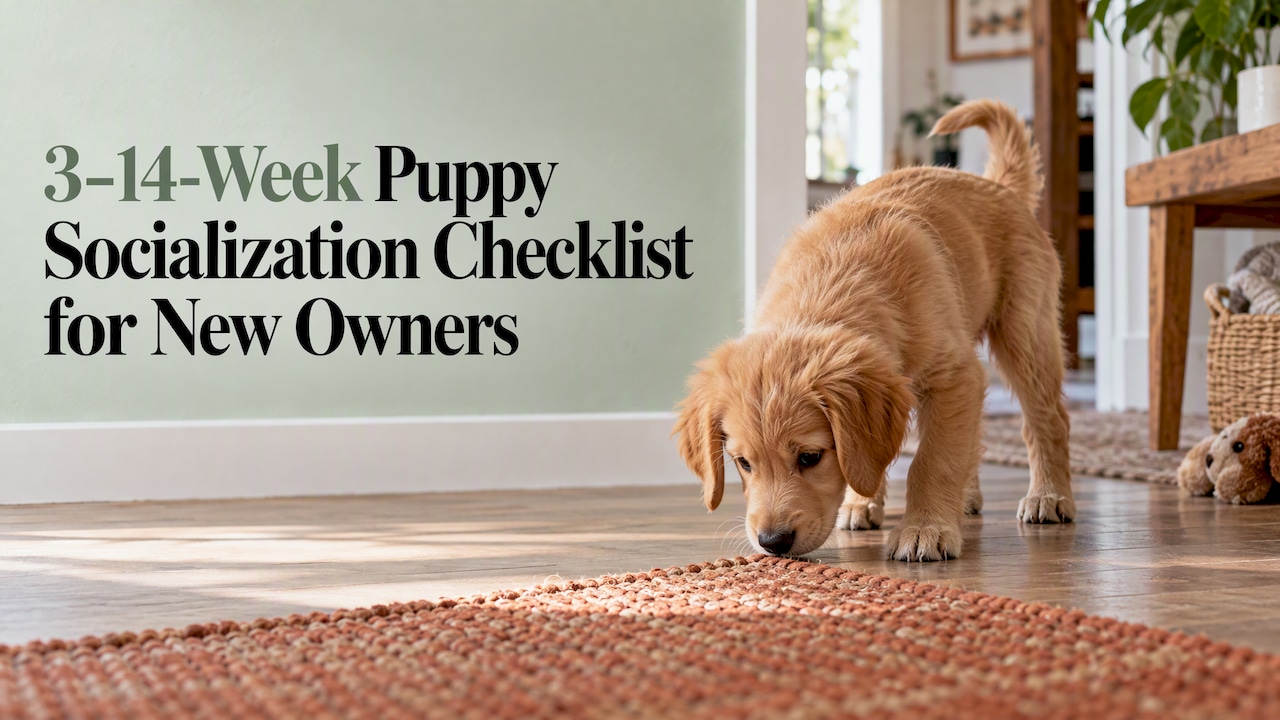

Start positive socialization now: brief, reward-based exposures during the sensitive window build a confident adult dog. Begin while your puppy is young, pair every new sight, sound, and person with treats or play, and let your puppy choose how close to get. You can start this safely before vaccines are finished by choosing clean, controlled settings and checking vaccine timing with your veterinarian.
TL;DR:
- Socialization during the 3 to 14 week window is crucial for shaping a confident adult dog and can be safely started before vaccines are complete in controlled environments.
- Introducing your puppy to new sights, sounds, and people in short, positive sessions builds familiarity and reduces fear, with brief exposures layered weekly for best results.
- Attending low-risk, supervised puppy classes after at least one vaccination does not increase infection risk and offers valuable social experiences during the critical period.
- Handling and grooming exercises, paired with treats, help your puppy become calm and cooperative during vet visits and grooming, even when started early.
- Gradual, positive social encounters with calm dogs and diverse people help prevent fearfulness, while avoiding overwhelming situations and recognizing stress signals promotes healthy social development.
Table of Contents
- Your week-by-week puppy socialization checklist
- When is the sensitive window for puppy socialization?
- How do you balance vaccination timing with safe socialization?
- Teaching handling, grooming, and vet-visit tolerance
- How to socialize your puppy with people and other dogs
- Common puppy socialization mistakes and warning signs
- What the research says about early socialization
- Our take on raising a confident puppy
- Keep building your puppy’s confidence
- FAQ
- Sources
A good plan does not need to be complicated. It needs to be consistent, short, and positive, repeated daily until new experiences stop feeling new.
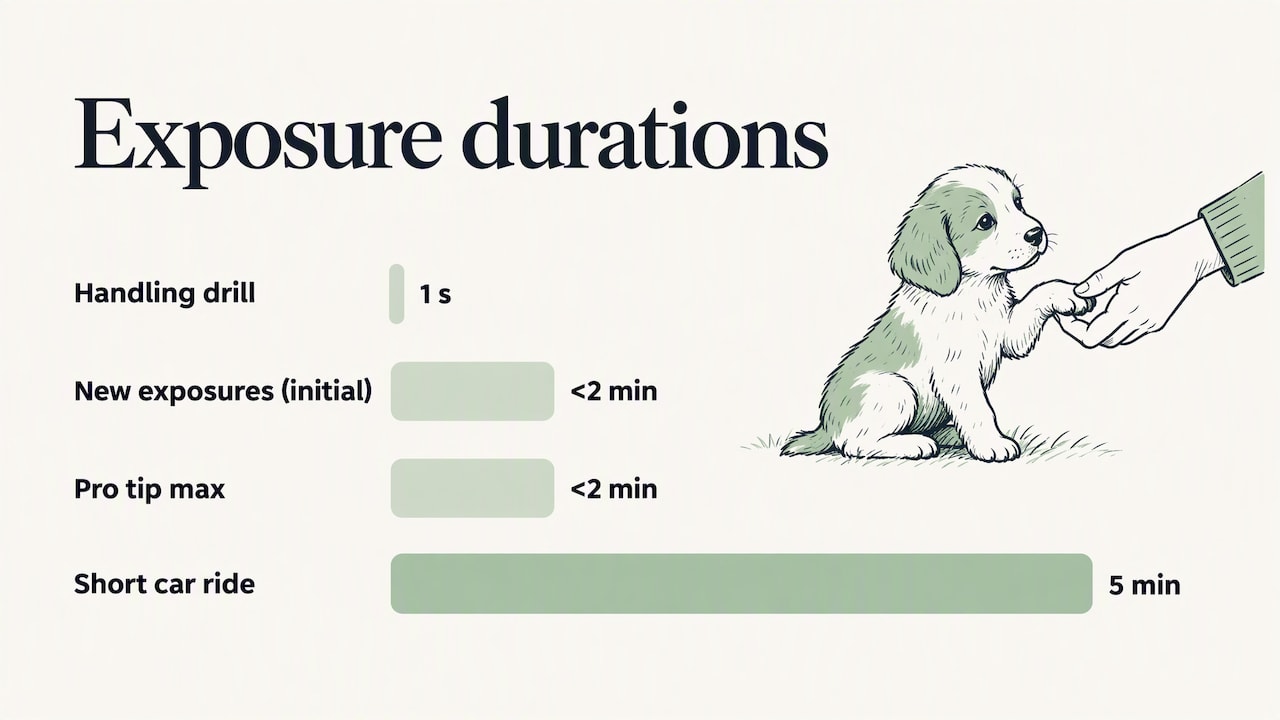
Start with daily handling drills. Touch an ear, a paw, or the mouth for a second, then follow immediately with a treat. These short sessions teach your puppy that human hands mean good things, which pays off later at the vet’s office or the groomer.
Each week, add new categories of exposure rather than repeating the same ones:
- Introduce three or four new types of people (someone in a hat, a person using a cane, a child, a delivery worker).
- Let your puppy walk on different textures: tile, grass, gravel, a wobbly cushion, a metal grate.
- Take a five-minute car ride to a new location, even if you just sit in the parking lot.
- Play recordings of thunderstorms, vacuums, or fireworks at low volume while your puppy eats a meal.
Once your puppy is comfortable with these basics, layer in social settings:
- Supervised puppy classes with other vaccinated puppies of similar size and age.
- Short playdates with one calm, known dog rather than a crowd.
- Brief visits to pet-friendly stores where you can carry your puppy if needed.
Pro Tip: Keep every new exposure under two minutes at first, and end on a good note, before your puppy gets tired or overwhelmed.
The most critical window for socialization falls between 3 and 14 weeks of age, according to research from UC Davis. Exposures during this stretch shape how your dog responds to new people, animals, and environments for life.
- Before 8 weeks: your puppy is usually still with the breeder, but gentle handling and exposure to household sounds and different people already matter.
- 8 to 14 weeks: this is the priority window for brief, supervised outings, new people, and puppy classes.
- After 14 to 16 weeks: the sensitive period is closing, but reinforcement and continued exposure still build confidence.
- Late-start puppies adopted after 16 weeks can still make progress through slow desensitization and counterconditioning, though it takes patience and sometimes professional support.
Many new owners wait until the full vaccine series is finished before socializing, and that delay can cost a puppy its most important developmental window. The alternative is choosing low-risk settings while vaccines are still in progress.
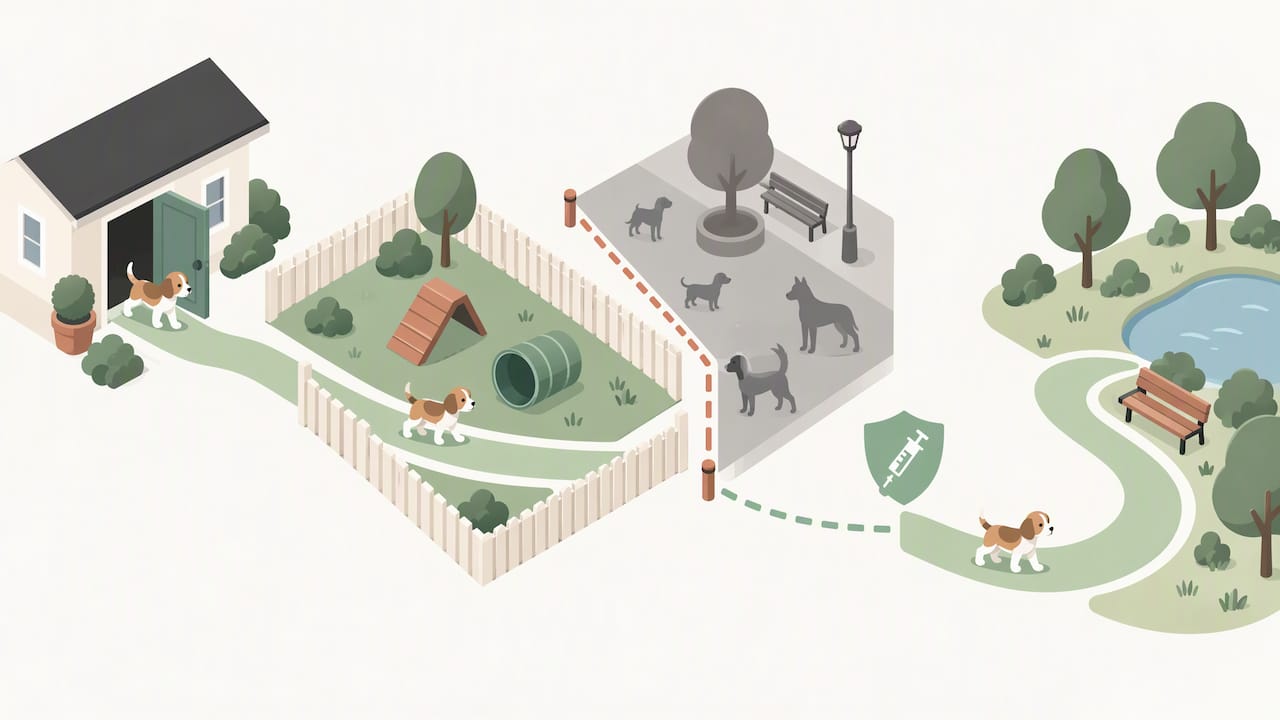
A study of 279 puppies found no increased risk of parvovirus infection among those attending socialization classes after at least one vaccination. That result supports supervised classes as a reasonable middle ground between isolation and unrestricted exposure.
Talk to your veterinarian about your puppy’s specific vaccine schedule, then use these guidelines:
- Choose indoor puppy classes that require proof of vaccination and clean, sanitized floors.
- Carry your puppy in public places like pet stores instead of letting paws touch the ground.
- Avoid unsanitized, high-traffic dog parks until the vaccine series is complete, since veterinary guidance flags these as higher-risk environments.
Teaching handling, grooming, and vet-visit tolerance
Cooperative care starts small. Touch a paw, an ear, or the base of the tail, then immediately offer a treat and release. Repeating this pattern daily, for just a minute or two, builds tolerance without any struggle.
Once your puppy accepts brief touches calmly, move into light grooming: a few strokes with a soft brush, a gentle hold around the collar, or lifting a lip to look at teeth. Keep sessions short and always end before your puppy pulls away.
- Introduce nail trimmers by letting your puppy sniff and lick peanut butter off the clippers before you trim anything.
- Practice a loose muzzle or handling similar to a vet exam, pairing it with treats, well before an actual visit.
- Stop immediately if your puppy stiffens or tries to escape, and shorten the next session.
Pro Tip: Practice “vet exam” poses, like holding the paw or looking in the ears, during calm moments at home, not only right before an appointment.
Not every interaction helps. A puppy swarmed by excited children or body-slammed by an overly rowdy adult dog can learn to fear both.
- Pick calm, vaccinated, well-socialized dogs for playdates, and keep groups small.
- Introduce diverse people gradually: someone wearing sunglasses, a hat, a wheelchair user, or a child, one at a time rather than all at once.
- Keep each greeting brief, two or three minutes, and end while your puppy is still relaxed.
- Watch for stress signals such as lip licking, yawning, tucked tail, or turning away, and remove your puppy from the situation if you see them.
A puppy that approaches, then hesitates and backs off, is showing mild uncertainty rather than calm curiosity. The better response is to step back with your puppy, reward any small step toward the new person or dog, and let your puppy set the pace rather than pulling or coaxing them forward.
The most frequent mistake is flooding: forcing a puppy to stay near something scary until it “gets used to it.” This usually backfires, teaching a puppy that scary things do not go away no matter what it does.
- Avoid long, overwhelming outings; short and frequent beats long and rare.
- Do not force physical contact when a puppy is backing away or hiding.
- Do not punish growling or barking at something new, since that often suppresses a warning without resolving the fear.
Watch for persistent freezing, extreme avoidance, or escalation into snapping or growling across multiple encounters. These signs call for a conversation with your veterinarian or a certified behaviorist rather than continued exposure on your own.
Veterinary and behavior organizations consistently back early, positive exposure. The AVMA’s literature review on socialization describes poor socialization as a driver of fear and behavioral problems later in life, and recommends continuing social exposure through the first year.
Professional organizations note that the behavioral risks of poor socialization outweigh the infectious disease risks when exposures happen in managed, low-risk settings.
The Purdue study of 279 puppies found no increase in parvovirus cases among puppies attending classes after their first vaccination. Combined with AVSAB’s position favoring early socialization, the evidence points toward supervised classes as a safe, practical choice rather than something to postpone.
Our take on raising a confident puppy
Socialization is not a checklist you finish and forget. It is daily, small, and often unglamorous: a treat for touching a paw, a calm walk past a skateboard, a five-minute visit to a new store. We built our puppy resources around that reality, favoring short and repeatable exercises over one big “socialization day” that tries to do too much at once. Balancing safety and social growth comes down to patience: a puppy that opts out today can opt in next week.
— Edwin
Keep building your puppy’s confidence
A single checklist cannot replace the day-to-day decisions that shape a well-adjusted dog, but ours gives new owners a clear starting point instead of guesswork about what to try first.

Our puppy care and socialization resources walk through handling drills, exposure checklists, and training tips in more depth, so you always know what to work on next.
- Browse our guides for age-specific socialization exercises.
- Find practical tips for handling, grooming, and cooperative care.
- Explore product recommendations that support training and enrichment at home.
Visit Best Pets Corner to find the next step for your puppy’s socialization plan.
FAQ
What is the 7-7-7 rule for puppies?
The 7-7-7 rule is a popular informal guideline suggesting puppies meet several new people, surfaces, and experiences early on, but it is not an official veterinary standard. The core idea, exposing puppies to a variety of safe experiences early, lines up with professional guidance on the 3 to 14 week sensitive period, even though the specific numbers are not research-backed.
Twenty weeks is past the primary sensitive window, but it is not too late to make progress. Puppies that start later can still build confidence through gradual desensitization and counterconditioning, though change tends to happen more slowly and may benefit from a trainer’s help.
What is the hardest month for a puppy?
There is no single universally “hardest” month, since every puppy’s fear periods and temperament differ. Many owners find the weeks right after a secondary fear period, often appearing sometime after 8 weeks, challenging because a puppy may suddenly react cautiously to things that did not bother it before.
Can I leave my 8-week-old puppy alone for 3 hours?
Most 8-week-old puppies cannot comfortably hold their bladder for 3 hours and may become distressed if left alone that long without a plan. Short, gradual alone-time practice paired with a safe, confined space works better than one long stretch, and it also supports the same gradual, positive approach used in socialization.